

ERA 7
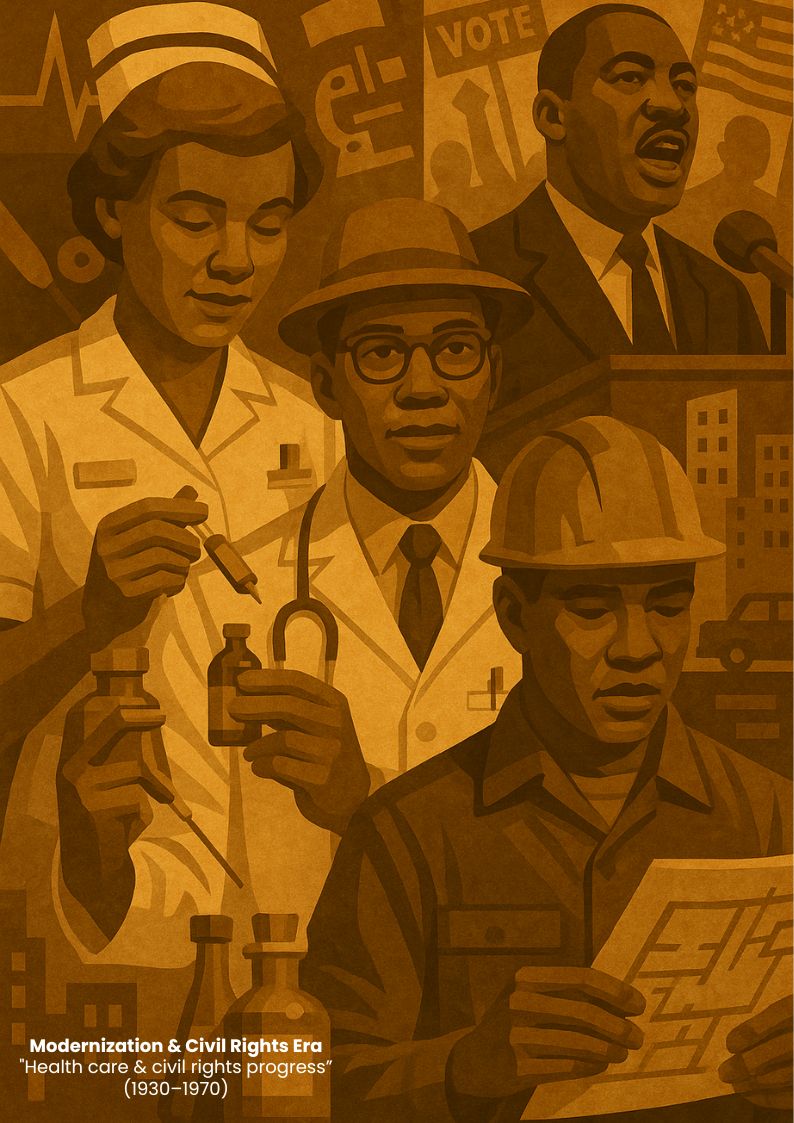
Modernization & Civil Rights Era
“Health Care & Civil Rights Progress”
(1930–1970)
What Was Happening Historically
This era carried America through the Great Depression, World War II, and the Civil Rights Movement — decades in which Black Americans fought for equal rights and access to education, jobs, and public spaces, even as Jim Crow segregation remained the law across much of the country. Wartime industrial demand opened some new doors — including a 1941 order banning racial discrimination in defense-industry hiring — while landmark civil rights legislation in the 1960s began dismantling legal segregation nationwide.
How Inventions Responded to Needs
Frederick McKinley Jones developed the first practical automatic refrigeration system for trucks and railcars, making it possible to transport fresh food safely over long distances for the first time — technology that reshaped the entire food supply chain and later co-founded the company known today as Thermo King.
Dr. Charles Drew pioneered techniques for processing and storing blood plasma, organizing the large-scale blood banks that saved countless lives during World War II and became the medical foundation blood donation programs still rely on today. Percy Julian, a chemist, found ways to synthesize medicines like cortisone from plant sources at a fraction of the previous cost, making treatments for arthritis and other conditions dramatically more accessible.
Richard Spikes patented an automatic gear shift and an automatic safety brake system for automobiles, improving both convenience and safety as car ownership expanded across the country. And near the end of this era, Marie Van Brittan Brown — concerned about slow police response times and safety in her neighborhood — invented the first home security system with audio-video monitoring, an idea now standard in millions of homes.
Freedoms or Limitations of the Time
Legal segregation under Jim Crow laws and widespread economic discrimination still limited opportunity and recognition for Black inventors throughout most of this era. Yet many pushed through anyway, gaining patents and transforming entire industries — often while working within institutions that offered them far less support than their contributions deserved. Their breakthroughs helped dismantle harmful stereotypes and demonstrated real leadership in science, medicine, and engineering, right alongside the broader fight for civil rights happening in the streets and courts around them.
Reflection Challenge
Share your answers to any of these questions in the comments below. Your ideas become part of the Gatherversity Library — a growing collection of insights from explorers just like you.
- What can we learn from this time to shape our future?
- How can we create solutions that protect and heal people? How can our ideas push society toward fairness and equality?
- Find an invention in your home or community that protects someone’s health or safety — something in your kitchen, your car, or your medicine cabinet — the way Frederick McKinley Jones’s refrigeration or Marie Van Brittan Brown’s home security system did. Who invented it, and what problem were they solving?
- Find an invention in your home or community that protects someone’s health or safety — something in your kitchen, your car, or your medicine cabinet — the way Frederick McKinley Jones’s refrigeration or Marie Van Brittan Brown’s home security system did. Who invented it, and what problem were they solving?
