

ERA 6
Industrial Revolution & Great Migration
“Rise of the Harlem Renaissance”
(1900–1930)
What Was Happening Historically
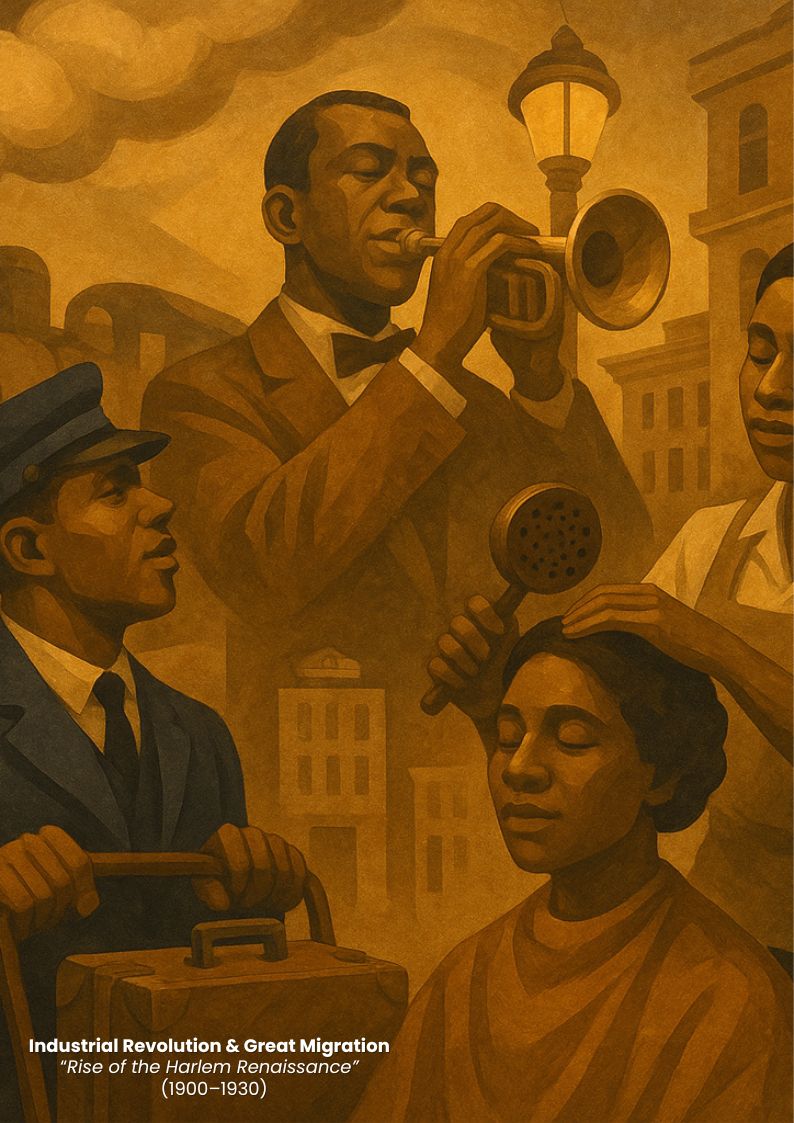
In the early 1900s, millions of Black Americans left the rural South for growing cities in the North, Midwest, and West in what became known as the Great Migration, seeking better jobs and safety from racial violence. Cities like Harlem became centers of Black culture, business, and creativity — while rapid industrialization was reshaping how Americans worked, traveled, and lived on a daily basis.
How Inventions Responded to Needs
Garrett Morgan became one of the most recognized inventors of the era, patenting a three-position traffic signal in 1923 that added a crucial “warning” position between stop and go, making city streets dramatically safer as automobile traffic exploded — and years earlier, in 1914, patenting a safety hood and smoke protector that he personally used to help rescue workers trapped during a tunnel explosion under Lake Erie, well before it became standard firefighting and industrial safety equipment.
Madam C.J. Walker built an entire haircare and cosmetics business around products she developed specifically for Black women’s hair — becoming, by most accounts, the first self-made female millionaire in America, and turning her company into an economic engine that employed thousands of Black women as sales agents nationwide. Together, their work reflected exactly what this era demanded: solutions built for growing cities and a growing, self-determined Black economy.
Freedoms or Limitations of the Time
Black inventors and entrepreneurs of this era had somewhat greater access to patent systems and business networks than earlier generations, but still operated inside a country enforcing strict racial segregation, employment discrimination, and frequent outright violence — real enough that Garrett Morgan sometimes used a white or Native American business partner to help sell his inventions successfully. Despite this, their innovations and businesses reached national scale and helped fuel the cultural and economic confidence of the Harlem Renaissance.
Reflection Challenge
Share your answers to any of these questions in the comments below. Your ideas become part of the Gatherversity Library — a growing collection of insights from explorers just like you.
- What can we learn from this time to shape our future?
- How can we solve big city or community problems today? What ideas could make our neighborhoods safer, healthier, and more connected?
- Look for something in your home or neighborhood that helps keep people safe while they travel, work, or gather in crowded spaces — the way Garrett Morgan’s traffic signal and safety hood did. Or think about a skill or product someone in your family or community has built a small business around, the way Madam C.J. Walker did.
- What problem were they solving, and could you design something similar for a challenge your own community faces today?
