

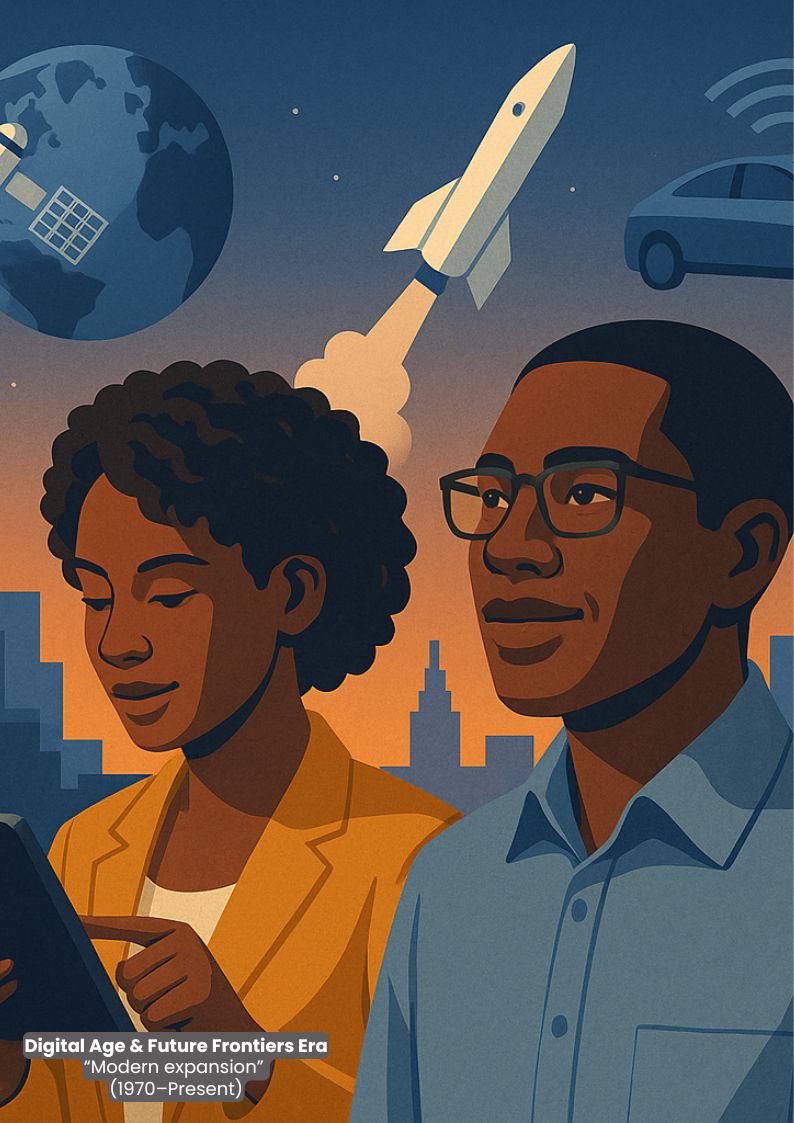
ERA 8
Digital Age & Future Frontiers Era
“Modern Expansion”
(1970–Present)
What Was Happening Historically
Since the 1970s, Black communities have seen major shifts: new civil rights gains, expanding access to higher education, and rising visibility in business, science, and technology. At the same time, systemic inequities have persisted — including funding gaps, underrepresentation in STEM fields, and barriers to leadership and investment — even as Black inventors have reached some of the highest levels of corporate, academic, and government innovation.
How Inventions Responded to Needs
Dr. Patricia Bath invented the Laserphaco Probe, a device that used laser technology to remove cataracts far more precisely than earlier methods — becoming the first Black woman physician to receive a patent for a medical invention, and helping restore sight to patients who had lost it to conditions once considered untreatable.
Dr. Mark Dean, a computer scientist and IBM Fellow, co-invented core architecture used inside personal computers, including the technology that let multiple devices — printers, disk drives, modems — connect to a single computer, foundational work behind the machines millions of people now use every day.
Lonnie Johnson, a former NASA engineer, applied his background in thermodynamics and energy systems to invent the Super Soaker — one of the best-selling toys in history — while also holding more than a hundred patents in energy conversion technology aimed at making renewable power more efficient.
Marian Croak holds over a hundred patents in Voice over Internet Protocol (VoIP) technology, the foundation that made internet-based phone calls possible, and later pioneered the text-message donation systems used to raise disaster relief funds after crises like the Haiti earthquake.
Freedoms or Limitations of the Time
Black inventors today have more access to education, patent systems, and professional networks than any previous era in this timeline — but real barriers remain, including funding gaps in venture capital, underrepresentation in STEM leadership, and structural inequalities that still shape who gets credit, investment, and recognition. Despite this, the inventors of this era have reached the highest levels of corporate and scientific leadership, continuing to push boundaries and shape what’s possible for the generations coming up behind them.
Reflection Challenge
Share your answers to any of these questions in the comments below. Your ideas become part of the Gatherversity Library — a growing collection of insights from explorers just like you.
- What can we learn from this time to shape our future?
- How can we use our creativity and skills to build a future that is fair, inclusive, and innovative? What big problems can we solve for the next generation?
- Look at a piece of technology you use every day — your phone, a computer, or a device at home — the way Dr. Mark Dean’s chip architecture or Marian Croak’s internet-calling technology quietly power the devices around you. Can you find out who helped invent something inside it?
- What’s one problem in your own life or community that doesn’t have a good solution yet — and what would it take for you to be the one who finally solves it?
