

ERA 1
Pre-Ancient Egyptian Times
“The Era of Observation, Invention & Early African Science”
(Before 3100 BC – 332 BC)
What Was Happening Historically
Long before Egypt became the empire most people picture, early African communities along the Nile Valley — and beyond it, in Nubia to the south — were already solving hard problems with careful observation. People needed reliable food, clean water, ways to heal the sick, and ways to track time across seasons. There was no single “science” yet, in the way we’d recognize it today — but there was patient, repeated testing of what worked, passed down and improved generation after generation.
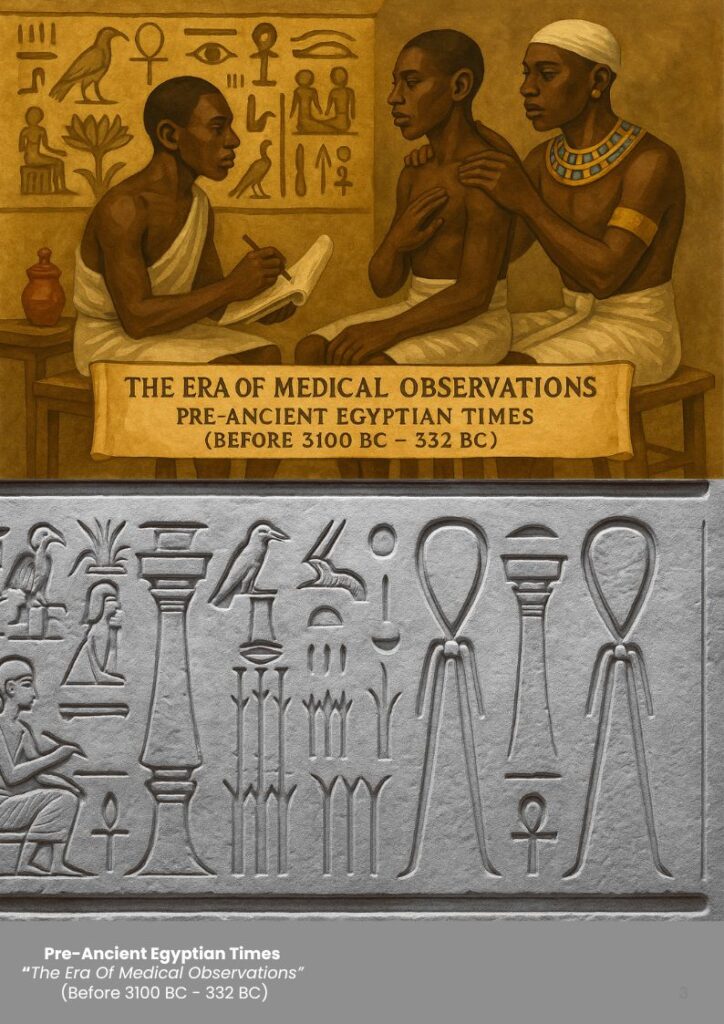
How Inventions Responded to Needs
This era produced far more than one brilliant mind — it produced entire systems of invention working together. Egyptian engineers developed the shadoof, a simple hand-operated tool that let farmers lift Nile water into their fields, turning unpredictable flooding into dependable irrigation. Scribes and healers created papyrus, transforming plant reeds into one of the world’s first practical writing materials — which meant knowledge, including medical knowledge, could finally be recorded and shared instead of lost.
That recorded knowledge became real medical texts: the Edwin Smith Papyrus describes surgical treatment for injuries in careful, case-by-case detail, and the Ebers Papyrus catalogs hundreds of remedies and diagnoses — both building on the same observation-based approach Imhotep helped pioneer as one of the first people in history to treat medicine as a science rather than magic. Egyptian mathematicians developed a working decimal number system and precise geometry accurate enough to align the pyramids to true north — a level of engineering precision that still impresses builders today.
Further south, Nubian metalworkers were mastering iron smelting, developing furnace techniques that would make the region — centered on the city of Meroë — one of the ancient world’s major iron-producing centers. Egyptian chemists also perfected mummification, a genuinely sophisticated process using natural salts and resins to preserve the body — real applied chemistry, thousands of years before the word “chemistry” existed.
Freedoms or Limitations of the Time
Most people in this era had no access to formal training — knowledge belonged to specific roles: priests, scribes, physicians, master craftspeople — and was often passed down within families or temple schools rather than taught broadly. Still, talent could open doors: Imhotep himself rose from a commoner’s background to become a royal advisor, architect, and physician, proving that skill and careful observation could matter more than birth, even in a rigid society. Tools were limited by what nature provided — stone, copper, reeds, natural minerals — which meant every invention had to work with those materials, not against them.
Reflection Challenge
Share your answers to any of these questions in the comments below. Your ideas become part of the Gatherversity Library — a growing collection of insights from explorers just like you.
- What can we learn from this time to shape our future?
- How does paying close attention — really watching and recording what happens — help us become better problem-solvers today, the same way it did for early Egyptian and Nubian innovators?
- Look around your own home or neighborhood: can you find something that solves a problem the same basic way the shadoof, papyrus, or early medical observation did — using a simple, patient method rather than a complicated one?
- If you lived in this era, with only the materials nature gave you, what’s one problem in your own life you think you could still find a way to solve?
