

ERA 4
Pre-Civil War Ingenuity
“Resilience Under Oppression”
(1790–1865)
What Was Happening Historically
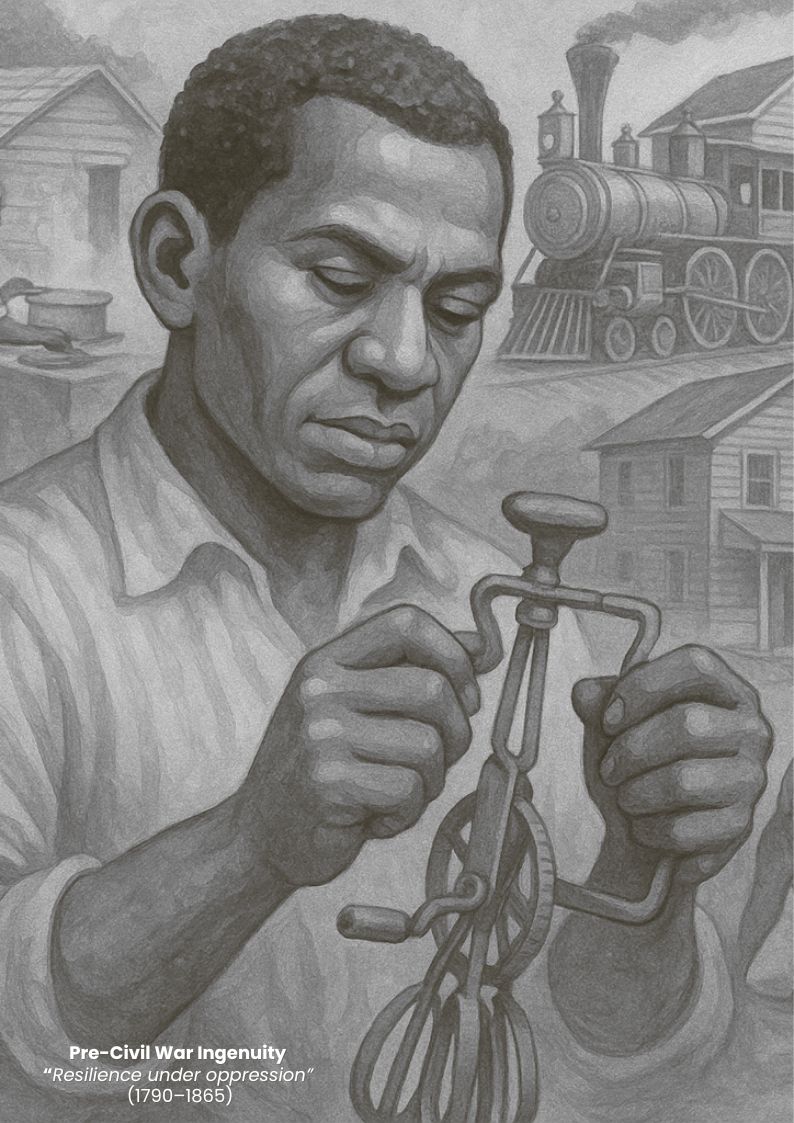
During this period, the vast majority of African Americans in the United States were enslaved, legally denied education, property ownership, and — in nearly every case — the right to hold a patent in their own name. U.S. patent law of the era offered no clear path for enslaved people to be legally recognized as inventors at all. And yet, free and enslaved Black people alike kept observing, adapting, and building solutions to the daily problems around them — in farm fields, kitchens, and workshops — often with no expectation of ever being credited for it.
How Inventions Responded to Needs
A small number of free Black inventors managed to break through this system anyway. Thomas Jennings, a free Black tailor in New York, became the first African American to receive a U.S. patent, in 1821, for a dry-cleaning process he called “dry scouring” — and used the profits to fund abolitionist work. Norbert Rillieux, a free man of color from Louisiana, engineered the multiple-effect evaporator, a device that transformed the dangerous, inefficient sugar-refining process into something safer and dramatically more productive — a design so effective its basic principle is still used in industrial evaporation systems today. Henry Blair, one of the few enslaved or formerly enslaved individuals ever recorded as a patent holder, invented improved seed planters for corn and cotton that let farmers plant faster and more evenly. And Augustus Jackson, a free Black chef, developed new manufacturing techniques for ice cream that made it possible to produce and sell it at a much larger scale — innovations that shaped an entire industry.
Freedoms or Limitations of the Time
Enslaved people were denied access to formal education, denied the right to own property, and denied any legal right to patent an invention under their own name — meaning countless tools, farming techniques, and household solutions created by enslaved inventors were used, and often profited from, by the very people who enslaved them. The handful of free Black inventors who did receive patents still had to navigate a legal and economic system built to exclude them at every turn. Their ingenuity found a way through anyway — proof that creativity cannot be legislated away, even when credit is.
Reflection Challenge
Share your answers to any of these questions in the comments below. Your ideas become part of the Gatherversity Library — a growing collection of insights from explorers just like you.
- What can we learn from this time to shape our future?
- Can we still innovate when the odds are against us? How do we turn struggle into solutions?
- Look around your own home or community for a tool that makes hard work easier — a shortcut or labor-saving device, the way Henry Blair’s seed planter or Norbert Rillieux’s evaporator did.
- Could you improve it further?
