

ERA 5
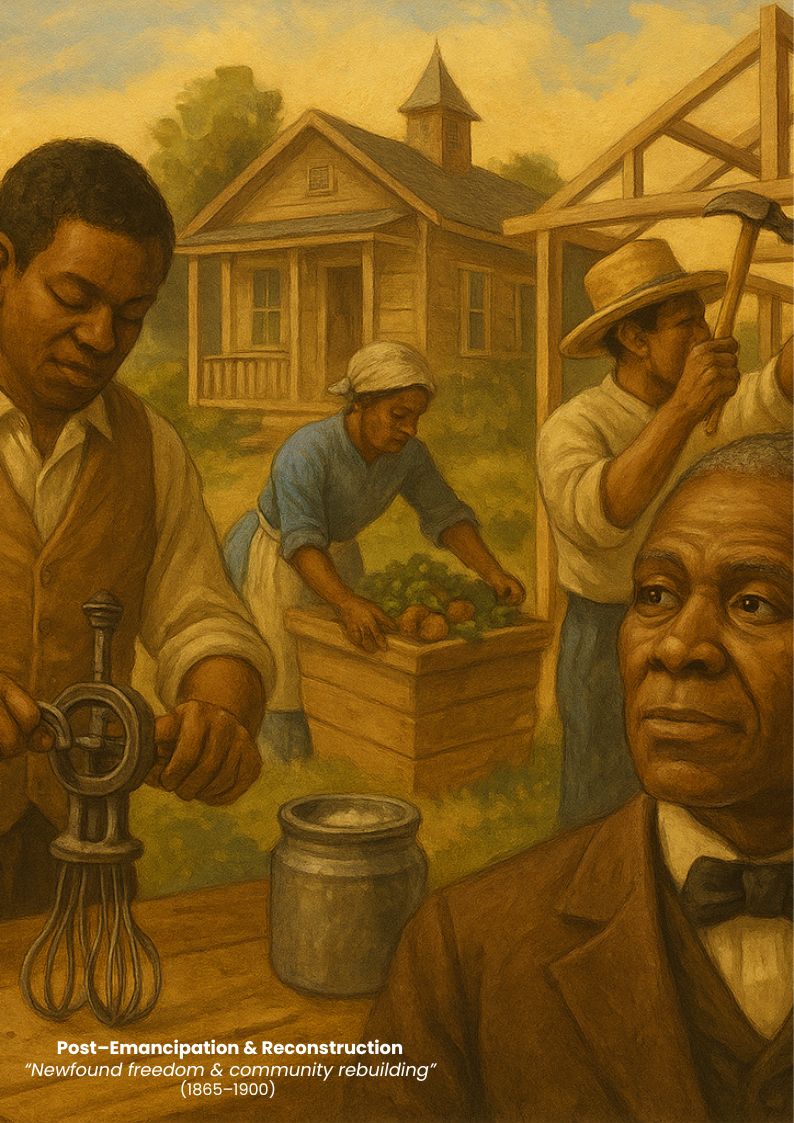
Post-Emancipation & Reconstruction
“Newfound Freedom & Community Rebuilding”
(1865–1900)
What Was Happening Historically
After the Civil War ended slavery in 1865, Black Americans gained the legal right to patent their own inventions for the first time in the nation’s history — a genuinely new freedom, even as Reconstruction-era violence, Black Codes, and the rise of Jim Crow segregation worked to limit what that freedom could actually mean in daily life. Communities focused on building their own schools, churches, and businesses, often from nothing, while still facing enormous resistance.
How Inventions Responded to Needs
With patent rights finally open to them, Black inventors began building solutions the whole country would come to rely on. Elijah McCoy, the son of formerly enslaved parents, developed an automatic lubricating device for steam engines so reliable that customers reportedly started asking for “the real McCoy” by name — a phrase still part of the language today. Sarah E. Goode became the first Black woman to receive a U.S. patent, for a folding cabinet bed that let people in small city apartments convert a bed into a working desk during the day — a clever space-saving solution for the crowded urban housing many freed families were moving into. Alexander Miles patented an improved automatic elevator door mechanism that closed elevator shafts safely on every floor, dramatically reducing a common and deadly accident of the era. And Granville T. Woods, sometimes called “Black Edison” for the sheer range of his work, patented dozens of inventions in railway signaling and communication, including a system that let moving trains communicate with stations to help prevent collisions.
Freedoms or Limitations of the Time
For the first time, Black inventors could legally file for and hold patents in their own names — a genuine and hard-won freedom. But that freedom came with real limits: many still needed white business partners or investors to manufacture and sell their inventions, faced legal challenges specifically because of their race, and lived inside a broader society enforcing segregation through Jim Crow laws. Still, the inventions of this era spread nationwide and, in cases like McCoy’s and Woods’s, became standard technology across entire industries.
Reflection Challenge
Share your answers to any of these questions in the comments below. Your ideas become part of the Gatherversity Library — a growing collection of insights from explorers just like you.
- What can we learn from this time to shape our future?
- How can we use new freedoms or opportunities to make life better for our families and communities? How do we turn small steps forward into big impacts?
- Find something in your home or community that makes a task safer or more efficient than it used to be — a door, a tool, a piece of equipment, the way Alexander Miles’s elevator door or Elijah McCoy’s lubricator did. Who do you think figured out how to make it better, and what problem were they solving?
- If you had just gained a brand-new freedom or opportunity, what’s the very first problem you’d want to solve for the people around you?
